
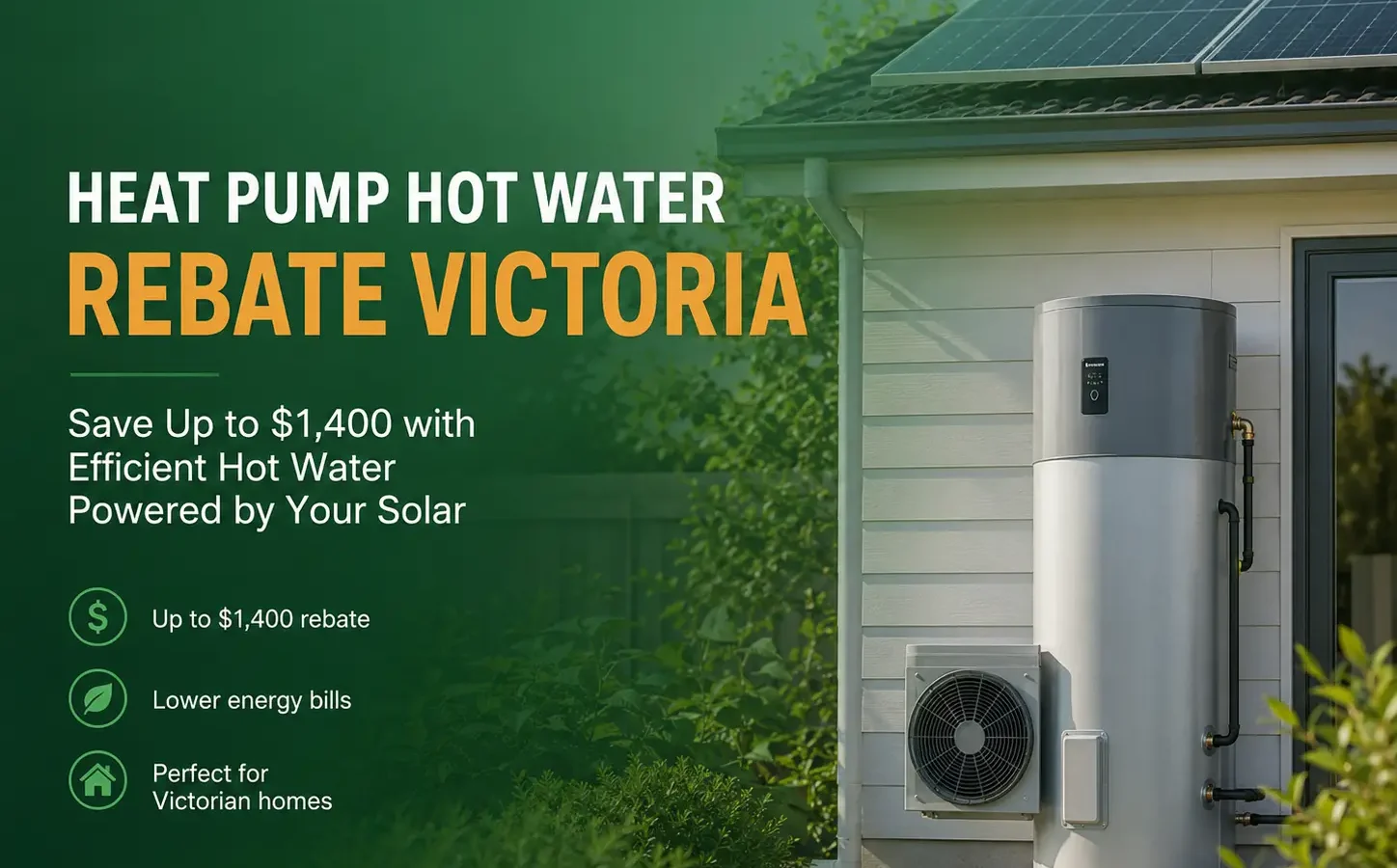
Hot water can account for a significant portion of household energy consumption, which is why replacing an ageing gas or conventional electric water heater with an efficient heat pump can make a meaningful difference to household energy use.
For eligible Victorian homeowners, the heat pump hot water rebate in Victoria can also reduce the upfront cost of making that switch.
Through the Solar Homes Program, eligible Victorian households can receive support toward approved heat-pump or solar hot-water systems, with higher rebate support available for certain eligible locally made products.
SolarAide installs heat pump hot water systems across Melbourne and Victoria and helps eligible customers manage the rebate process from system selection through installation.
What Is the Victorian Hot Water Rebate?
The Solar Victoria Hot Water Rebate is designed to help eligible households replace inefficient hot water equipment with approved energy-efficient alternatives.
Eligible installations may include:
- Heat pump hot water systems
- Approved solar hot water systems
SolarAide provides a dedicated guide to the current Hot Water Rebate Victoria, including the process and current rebate structure.
Because rebate criteria and eligible product lists can change, homeowners should confirm eligibility before purchasing or installing equipment.
Why Heat Pumps Are Becoming Popular in Victoria
A traditional electric storage water heater creates heat using an electrical resistance element.
A heat pump works differently.
Instead of creating all of the heat directly from electricity, it transfers thermal energy from the surrounding air into the water.
The principle is similar to how refrigeration or reverse-cycle air conditioning moves heat from one place to another.
This can make a modern heat pump considerably more efficient than conventional electric resistance hot water.
For Melbourne homes moving away from gas, it also provides a practical electric alternative.
Heat Pump Hot Water and Solar Panels
Heat pumps become especially interesting when a home already has rooftop solar.
Solar panels produce electricity during daylight hours.
A heat-pump hot-water system can be scheduled to operate primarily during that same period, allowing more of the home’s water heating to be powered by its own solar generation.
Instead of exporting excess solar electricity and later purchasing energy to heat water, the household can use more of its generation behind the meter.
SolarAide therefore treats residential solar and heat-pump hot water as parts of the same household energy strategy.
How Much Is the Hot Water Rebate in Victoria?
Under the current Solar Homes settings, eligible households may receive:
- Up to $1,400 for certain eligible locally made hot-water products
- Up to $1,000 for other eligible hot-water products
The actual support available depends on the product, household and program eligibility.
Other incentives, including applicable STCs and Victorian Energy Upgrades support, can also affect the final installation cost.
Because these programs evolve, the smartest approach is to assess the current eligibility at the time a quote is prepared rather than basing a purchase decision on an old advertisement floating around the internet, where expired rebate information goes to enjoy its retirement.
Who Should Consider a Heat Pump?
A heat-pump hot-water system can make particular sense for Victorian households that:
- Have an ageing gas hot-water system
- Have an old electric storage tank
- Already have rooftop solar
- Want to reduce gas consumption
- Are planning an all-electric home
- Want to make greater use of daytime solar
- Are replacing an inefficient hot-water system
- Want to reduce household energy demand
The right solution still depends on household size and hot-water consumption.
What Size Heat Pump Does a Melbourne Home Need?
SolarAide generally works with household heat-pump systems sized according to actual demand rather than choosing equipment simply because it has a larger tank.
Residential systems may commonly fall somewhere around 160 to 300 litres, depending on the product and household requirements.
Important factors include:
- Number of occupants
- Shower and bathing patterns
- Available installation space
- Current hot-water system
- Peak household demand
- Solar generation
- Desired operating schedule
A family home with several occupants will normally have very different hot-water requirements from a two-person household.
Switching From Gas to Electric Hot Water
Victoria is steadily moving toward household electrification.
For homeowners, replacing gas hot water with a heat pump can be one of the most straightforward steps in that transition.
An all-electric household can potentially use rooftop solar to support:
- Hot water
- Cooking
- Heating
- Cooling
- EV charging
- General household electricity use
SolarAide’s broader home energy services are designed around this integrated approach.
Rather than installing solar, batteries, hot water, air conditioning and EV charging as unrelated products, the systems can be planned around how electricity moves through the home.
Pairing Heat Pumps With Battery Storage
A battery is not required to run a heat pump.
In many cases, the most efficient strategy is simply scheduling hot-water heating during daylight hours while solar generation is available.
However, battery storage can become useful where the household has a larger overall electrification strategy.
For example, a home might use:
- Solar during the day
- A heat pump scheduled around solar production
- A home battery for evening electricity use
- Reverse-cycle air conditioning for heating and cooling
- A smart charger for an electric vehicle
Together, these technologies can reduce dependence on both grid electricity and household gas.
Heat Pumps and Reverse-Cycle Air Conditioning
Water heating is only one part of household electrification.
Gas space heating can also be replaced or reduced through high-efficiency reverse-cycle systems.
SolarAide provides reverse-cycle air conditioning installation that can work alongside rooftop solar.
This creates a useful sequence for homeowners planning to electrify:
- Generate electricity with rooftop solar.
- Move hot water from gas to an efficient heat pump.
- Replace gas space heating with reverse-cycle systems where appropriate.
- Add battery storage where the consumption profile supports it.
- Integrate smart EV charging when required.
The exact order depends on the property, but planning the systems together can prevent expensive redesigns later.
Heat Pump Installation Across Melbourne Suburbs
SolarAide installs energy systems across metropolitan Melbourne and wider Victoria, with a particularly strong local presence in Melbourne’s south-east.
Service areas include communities such as:
- Dandenong
- Clyde
- Berwick
- Cranbourne
- Clayton
- Glen Waverley
- Bayswater
- Donvale
- Lilydale
- Box Hill
- Doncaster
- Brighton
- Werribee
- Melbourne CBD and surrounding areas
Melbourne’s mix of established properties, newer developments and growing all-electric homes means heat-pump requirements can vary significantly between suburbs and individual properties.
Why Use Solar During the Middle of the Day?
A home solar system is generally producing most strongly during daylight hours.
If nobody is home, much of that energy may otherwise be exported.
Programming a heat pump to operate during the solar-production window can effectively use the hot-water tank as a form of thermal storage.
The system heats the water while solar electricity is available, and the stored hot water remains available later when the household needs it.
It is a simple idea, but often a useful one.
Hot Water Rebate Victoria FAQs
How much is the heat pump rebate in Victoria?
Eligible households can currently receive up to $1,400 for qualifying locally made products or up to $1,000 for other eligible hot-water products.
Can I run a heat pump on solar?
Yes. A properly configured system can be scheduled to operate during daytime solar-production hours.
Can a heat pump replace gas hot water?
Yes. Heat pumps are one of the main efficient electric alternatives to gas hot-water systems.
Does SolarAide handle the rebate?
SolarAide checks eligibility and helps manage the relevant rebate paperwork for eligible installations.
Does SolarAide install heat pumps outside Dandenong?
Yes. SolarAide services Melbourne suburbs and wider Victoria.
Should I install solar before a heat pump?
You do not need solar to operate a heat pump, but combining the two can allow more hot-water energy to come from your own rooftop generation.
Get a Heat Pump Hot Water Quote in Melbourne
For many Victorian households, moving from gas or an ageing electric water heater to an efficient heat pump can be an important step toward lower household energy consumption and greater electrification.
When combined with solar, the system can make productive use of electricity your roof is already generating.
SolarAide provides heat-pump hot-water installation throughout Melbourne and Victoria and can help eligible homeowners navigate the current rebate process.
Request a free SolarAide heat-pump quote and we can assess your existing hot-water system, household demand, solar setup and available rebate options.