
What’s included
- Smart, app-controlled charging
- Schedules to your solar
- 7 kW and 22 kW options
- OCPP-compatible units
- Load balancing with the home
- Licensed electrical install
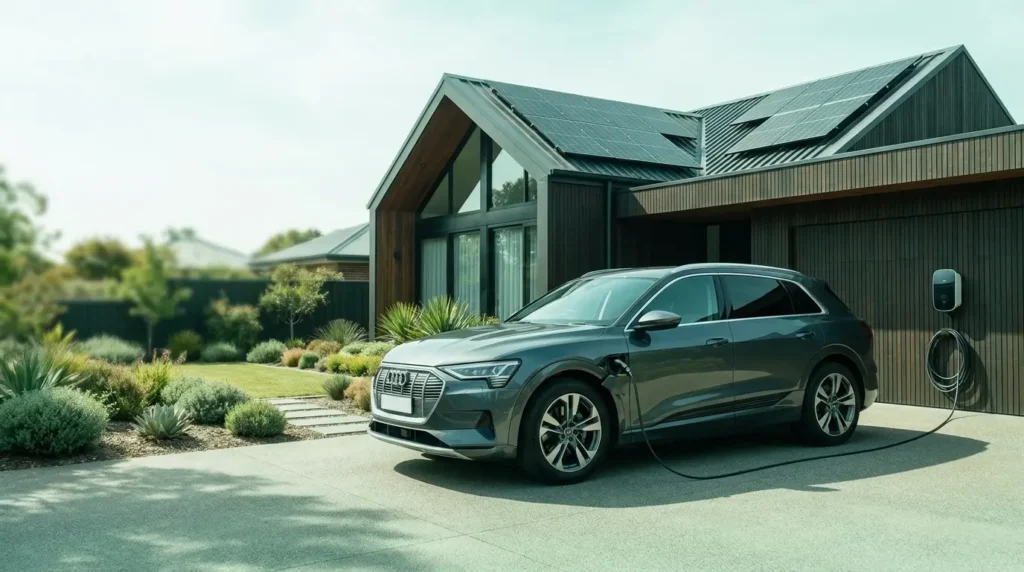
Charge your EV on your own solar
A good home charger does more than fill your battery, it charges from your solar and cheap off-peak power, so you skip peak rates that can cost up to ten times more. SolarAide installs smart, properly integrated chargers that work with your solar, battery and tariff, not against them.
A cheap charger bought online and fitted by a general electrician usually isn’t configured to talk to your solar or battery so it drains the grid (or your home battery) instead of using free daytime solar. We size, supply and install the whole setup so it’s done right EV charger installation Melbourne and Victoria.
Why integration matters: a well-configured charger fills your car from surplus solar without draining your home battery. Poorly set up, it just empties your battery into the car and leaves your home on the grid overnight.
Why choose SolarAide for your EV charger
Solar-smart charging
Your charger follows your solar output, topping up the car with the cheapest power you’ll ever use — your own.
Properly integrated
Configured to your tariff, inverter and battery so it never drains your home storage into the car.
Licensed install
A dedicated cable back to your switchboard, installed and certified by accredited electricians.
Future-proofed
OCPP-compatible units and 3-phase options so your setup keeps up with newer, faster-charging EVs.
Level 1 vs Level 2 — what you actually need
Level 1 (trickle charging) uses a standard power point at about 2 kW — roughly 10 km of range per hour. That’s 30+ hours for a full charge on many EVs, and constant high-amp draw from a normal socket carries real safety risks. Fine as an emergency backup in the boot; not for daily charging.
Level 2 (hard-wired home charger) runs at 7 kW to 22 kW — three to ten times faster. A 7 kW charger adds about 40 km of range per hour; a 22 kW 3-phase charger adds about 125 km per hour. This is what SolarAide installs for everyday home charging.
Your real-world speed depends on two things: whether your home has single- or 3-phase supply, and your car’s maximum AC charge rate (many EVs cap at 7 kW; modern Teslas at 11 kW; only a few models accept the full 22 kW).
Single-phase or three-phase?
Every modern EV charges at 7 kW (~40 km/hour added) on a single-phase charger. If your home has 3-phase supply, a 3-phase charger can reach 22 kW (~125 km/hour).
Our tip: if you have 3-phase supply, get a 3-phase charger. The hardware costs about the same, install is only slightly more, and you future-proof for faster-charging EVs — even if your current car can’t use the full speed yet.
Smart vs “dumb” chargers
A basic charger charges as fast as possible every time you plug in. A smart charger decides when and how fast to charge based on time of day, your tariff, surplus solar and your home battery level.
If you have solar, a smart charger is worth it, it can cut or even eliminate your charging cost by running on surplus solar. Without solar and on a flat tariff, the extra features matter less. SolarAide will tell you honestly which makes sense for your setup.
How we set it up with your solar and battery
With solar: we enable smart solar charging so the charger monitors your surplus and diverts it into the car filling up on behind-the-meter solar at just a few cents per kilometre.
With a home battery: we configure the system so your battery powers your home rather than emptying into the car, either through wiring or software when the charger and battery share a brand. You get the benefit of both without one cannibalising the other.
The plug and the essential feature
Unless your EV is pre-2020 or a special import, it uses a Type 2 (CCS2) plug the standard SolarAide installs.
The one feature worth insisting on is OCPP (Open Charge Point Protocol). It keeps your charger open to third-party apps and future tariff/grid integrations, and most other smart features (load management, timers, secure PIN access, per-user tracking) can be added in software on top of it.
How we install it
- Free consult & quoteWe check your supply, switchboard, solar and where you park.
- Recommend the right unitMatched to your car’s charge rate, your phase supply and your solar/battery setup.
- Licensed installationDedicated cable to your switchboard, usually done in half a day.
- Configure & testWe set up solar-aware charging and the app so it runs on sunshine from day one.
Frequently asked questions
How fast will it charge my car?
A hard-wired home charger adds about 40 km of range per hour at 7 kW, or up to 125 km per hour at 22 kW on 3-phase — versus roughly 10 km per hour from a standard power point. Your car’s maximum AC charge rate sets the ceiling.
How much does it cost to run compared to petrol?
Roughly: petrol is about $16 per 100 km; home charging on a standard tariff about $5.40; and charging on your own surplus solar as little as $0.54 per 100 km. Solar is by far the cheapest fuel.
Can I just install a charger myself?
You can plug in a portable trickle charger, but any hard-wiring to your switchboard is electrical work that legally requires a licensed electrician — and chargers above 4.6 kW usually need network approval. We handle both.
Do I need solar to make it worthwhile?
No, but it helps a lot. With a 10 kW+ solar system you’ll usually have enough surplus for a smart charger to run the car almost for free. Without solar, a smart charger can still save money by charging on cheap off-peak rates.
What about vehicle-to-home / vehicle-to-grid (V2G)?
V2L (running appliances from your car) is available now on many EVs. True V2G/V2H needs CEC-certified bi-directional chargers, which aren’t available in Australia yet. For now, the better move is a home battery with your solar — often eligible for the federal battery rebate.
Ready to charge on sunshine?
SolarAide installs smart, solar-integrated EV chargers across Melbourne and Victoria sized to your car, your supply and your solar. Get a free quote and we’ll recommend the right unit and set it up properly.