
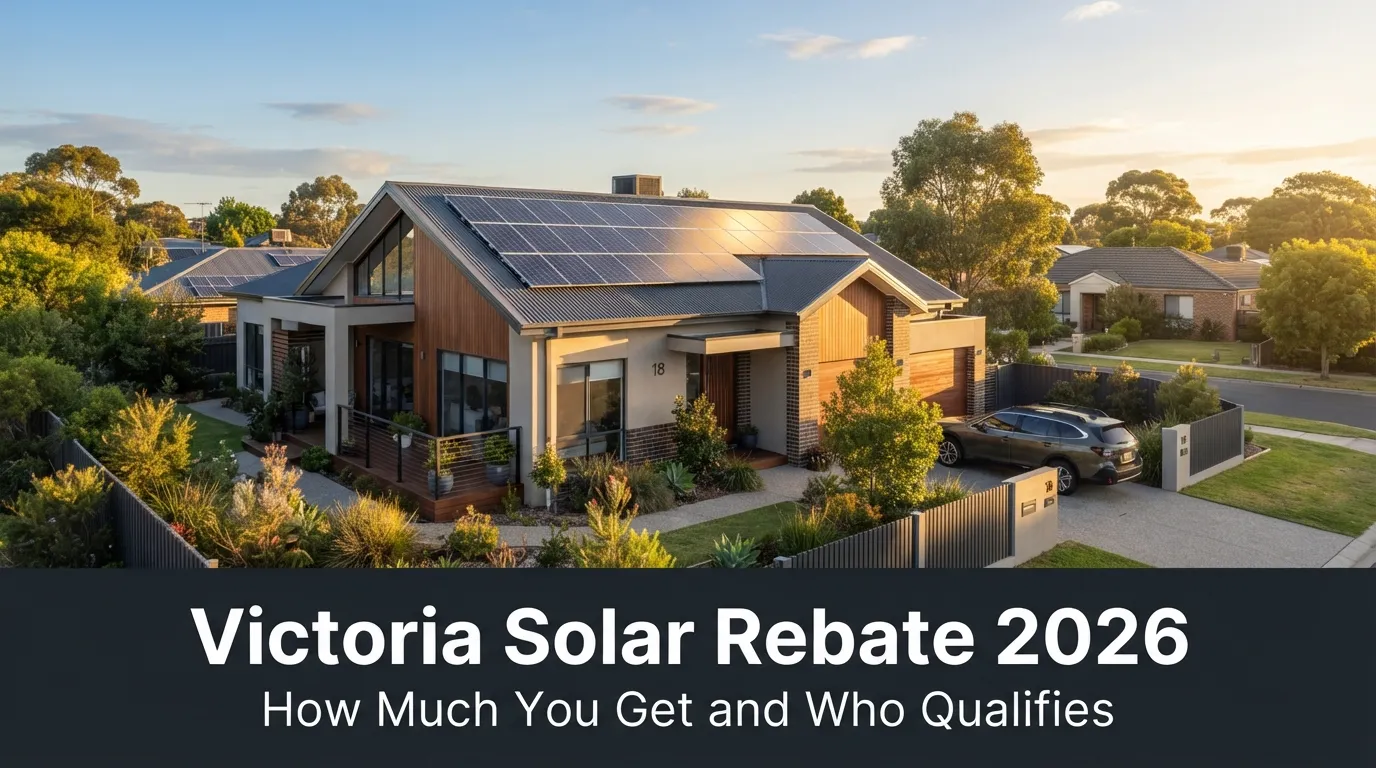
The guide outlines Solar Victoria rebate 2026, including the up to $1,400 rooftop solar discount, an optional interest-free loan, and a separate federal battery incentive. It explains how the rebate is applied by approved retailers and how state and federal programs can be combined.
It also details the July 2026 eligibility change that lowered the household income cap to $150,000, along with other qualification rules. The post notes that solar value now depends more on self-consumption than feed-in tariffs and encourages timely applications.
If you live in Melbourne or regional Victoria and you’re weighing up solar, the biggest question is usually the same. How much will the rebate actually take off the price, and do I qualify?
This guide answers both in plain English. You’ll find the current 2026 rebate amounts, who’s eligible after the July 2026 rule change, how the money comes off your quote, and how the state and federal incentives stack together. Everything reflects the rules as they stand in 2026, and where the government is the source of truth, we link you to it.
Solaraide is a Clean Energy Council Approved Solar Retailer and Solar Victoria accredited, so we handle these rebate applications for our customers every week. Here’s what you need to know.
Quick summary
Here’s the whole picture in six lines:
- Eligible Victorian owner-occupiers can get up to $1,400 off a rooftop solar system through the Solar Homes Program.
- There’s an optional interest-free loan of up to $1,400 on top, to spread the rest of the cost.
- A separate federal battery rebate can take roughly $2,500 off a typical 10 kWh battery.
- From 1 July 2026, the income eligibility cap dropped from $210,000 to $150,000 combined household income.
- The rebate is applied as a discount on your installer’s invoice. You don’t claim it back later.
- You must not install before your eligibility is approved, or you forfeit the rebate.
The rest of this guide explains each point in detail.
What is the Solar Victoria rebate?
The rebate most people mean is the Solar Homes Program, run by Solar Victoria (the state government body). Since it launched in 2018 it has helped install over 850,000 rooftop solar systems across the state, and rooftop solar now generates around 10 percent of Victoria’s electricity.
The program gives eligible households a point-of-sale discount toward the cost of installing a rooftop solar (PV) system. It is not a cheque that arrives later. Your approved retailer applies for it on your behalf, and the value is deducted from what you pay.
How much is the solar rebate in Victoria in 2026?
For solar panels (PV), eligible owner-occupiers can receive up to $1,400. On top of the rebate, you can choose an interest-free loan of up to $1,400, repaid over four years, to reduce your upfront outlay further.
The Solar Homes Program also includes related rebates that many households claim at the same time:
Hot water rebate. Up to $1,400 toward an eligible heat pump or solar hot water system. Solar panels can run a heat pump during the day for near-zero hot water running costs, which is why the two upgrades pair well.
Solar for rental properties. Landlords can access a rebate of up to $1,400 for eligible rental homes.
Solar for Apartments. Funding to help apartment buildings and owners’ corporations install shared solar.
If you want a system sized to your actual power bills rather than a one-size quote, that’s exactly the kind of assessment we do before recommending anything.
Who is eligible for the Victoria solar rebate?
This is where the most important 2026 change happened, so read this part carefully.
To qualify for the solar panel (PV) rebate, you generally need to meet all of the following:
- Be an owner-occupier of the property. (Separate streams cover rental providers and apartments.)
- Have a combined household taxable income under $150,000 per year. This threshold dropped from $210,000 on 1 July 2026. Applications submitted after 30 June 2026 are assessed against the new $150,000 cap.
- Own a home valued under the program’s property-value threshold.
- Not have already received a Solar Homes PV rebate at that property. (If you’ve moved house, you may still be eligible.)
- Not install the system before your eligibility is approved. Installing early means you forfeit the rebate.
The rebate amount itself did not change in July 2026. What changed is who qualifies. Households earning between $150,001 and $210,000 combined were eligible before the cutover and generally are not now. If your income is near that line, it’s worth confirming your position before you commit.
Eligibility criteria can be updated by Solar Victoria. For the current, authoritative rules, always check solar.vic.gov.au, and we’ll confirm your eligibility as part of your quote.
How the rebate gets applied (you don’t chase it)
One of the most common worries we hear is “how do I claim it back?” You don’t, and that’s the point. Here’s the process from start to finish:
- Get a quote from an approved solar retailer like Solaraide.
- We submit your rebate application to Solar Victoria and wait for your eligibility to be approved.
- Once your application is started, Solar Victoria emails you a secure application link to continue the process.
- Open the link, complete your application, and upload the required documents for verification.
- We install your solar system once your rebate application has been approved.
- The rebate is deducted from your invoice, so you only pay the remaining balance. If you’ve chosen the interest-free loan, it’s processed alongside your rebate and paid directly to us.
Rebates are released in monthly batches. If a monthly release runs out, your application is held and assessed in the next release. That’s another reason not to leave it to the last minute.
The federal battery rebate (a separate saving)
If you’re adding battery storage, there’s a second, federal incentive on top of anything from Solar Victoria. It’s called the Cheaper Home Batteries Program, and it’s delivered through the same certificate scheme that discounts solar panels.
Since 1 May 2026 the battery rebate has been tiered by size. The first 14 kWh of usable capacity attracts the strongest rate, around $252 per usable kWh, which is roughly $2,500 off a typical 10 kWh battery. Capacity beyond that tier attracts reduced rates. The rate steps down again on 1 January 2027, so the incentive is most generous the sooner you install.
Like the solar rebate, it’s applied as an upfront point-of-sale discount by an accredited installer. You don’t apply separately. To qualify, the battery generally needs to be between 5 and 100 kWh, paired with solar, and installed by a Solar Accreditation Australia (SAA) accredited installer using a CEC-approved battery.
Does solar still make sense with lower feed-in tariffs?
Yes, but the value has shifted. Victoria’s mandatory minimum feed-in tariff framework has ended, and retailers now set their own export rates, which have fallen. That means the real return on solar in 2026 comes from self-consumption, using your own power as you generate it, rather than exporting it for a few cents.
In practice that changes how a good installer sizes your system: to your daytime usage pattern, not just your roof space. It’s also why batteries and heat pumps have become more attractive. They let you shift more of your generated solar into the hours you actually use power.
What to do next
The rebate landscape rewards acting deliberately rather than rushing or waiting indefinitely. Three things worth doing now:
- If your income is near the $150,000 cap, confirm your eligibility before you plan an install.
- If you’re considering a battery, remember the federal rate steps down again on 1 January 2027.
- Get a system sized to your bills, from an accredited retailer who handles the paperwork.
Solaraide is CEC-approved and Solar Victoria accredited, and we manage the rebate application from start to finish for homes across Melbourne’s south-east and regional Victoria. Get a free, no-obligation quote and we’ll confirm exactly which rebates you qualify for and what you’d pay after they’re applied.
Frequently asked questions
How much is the solar rebate in Victoria in 2026?
Eligible owner-occupiers can receive up to $1,400 toward a rooftop solar (PV) system through the Solar Homes Program, plus an optional interest-free loan of up to $1,400. A separate federal battery rebate can take roughly $2,500 off a typical 10 kWh battery.
Who is eligible for the Victorian solar rebate?
You generally need to be an owner-occupier with a combined household income under $150,000 per year (reduced from $210,000 on 1 July 2026), own a home under the program’s value threshold, and not have previously claimed a PV rebate at that property. You must not install before your eligibility is approved.
Do I have to claim the rebate back myself?
No. Your approved retailer applies for the rebate on your behalf and the value is deducted from your invoice, so you only pay the balance. You never chase a reimbursement.
Can I get the solar rebate and the battery rebate together?
Yes. The Victorian Solar Homes rebate for solar panels and the federal Cheaper Home Batteries Program for battery storage are separate incentives, and they can be combined on the same project.
Is solar still worth it in Victoria with lower feed-in tariffs?
Yes. With retailer-set feed-in rates now lower, the main value comes from self-consumption, using your own solar as you generate it. Sizing the system to your daytime usage, and adding a battery or heat pump, is how most Victorian homes get the strongest return in 2026.
What happens if the monthly rebate release runs out?
Rebates are issued in monthly batches. If a release is exhausted, your application is held and assessed in the next available release, so it’s best not to leave your application until the last minute.
1 comment
nice