
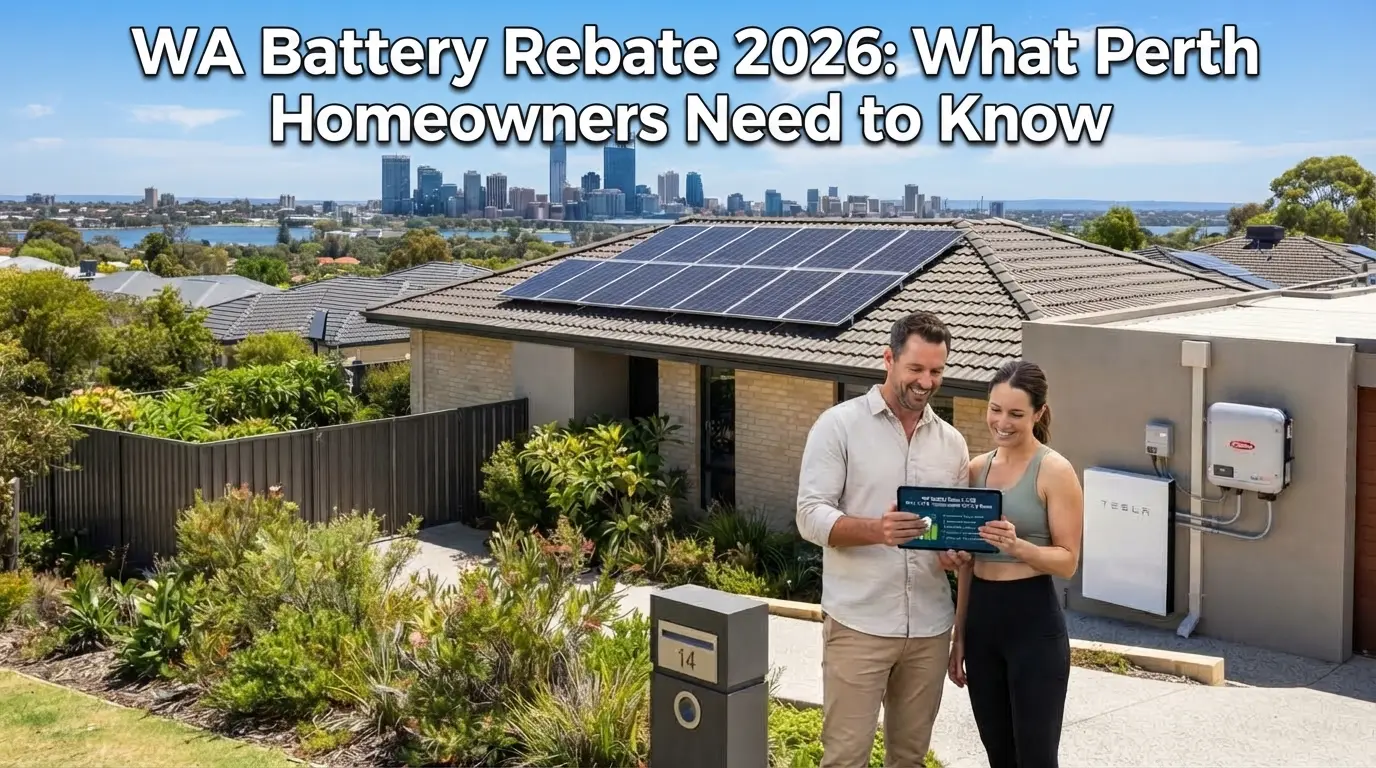
Home battery storage has become a much more serious option for Western Australian households, particularly for homeowners who already have rooftop solar and want to use more of the electricity they generate themselves.
For Perth households, the combination of the WA Residential Battery Scheme and the Australian Government’s Cheaper Home Batteries Program can significantly reduce the upfront cost of an eligible battery installation.
But the rebate is not simply a discount that applies to any battery you choose.
Battery capacity, approved equipment, installer requirements, Virtual Power Plant participation and the compatibility of your existing solar system all matter.
SolarAide provides solar and battery installation across Perth and surrounding areas from our Bayswater WA location, helping homeowners assess their existing solar system, battery requirements and available incentive options before installation.
What Is the WA Battery Rebate in 2026?
The WA Residential Battery Scheme is a Western Australian Government program designed to help eligible households purchase and install residential battery storage.
Under the current scheme, eligible customers can receive rebates of up to:
- $1,300 for Synergy customers
- $3,800 for Horizon Power customers
The maximum state rebate is based on up to 10kWh of usable battery capacity. Larger eligible batteries can still participate in the scheme, but the WA rebate itself does not continue increasing beyond the applicable maximum.
For homeowners across metropolitan Perth, the Synergy rebate is particularly relevant where the household meets the program requirements.
Can the WA Battery Rebate Be Combined With the Federal Battery Discount?
Yes.
The WA Residential Battery Scheme operates alongside the Australian Government’s Cheaper Home Batteries Program, subject to the eligibility requirements of both programs.
This means an eligible Perth household may potentially receive:
WA state battery support
plus
federal battery support through the Small-scale Renewable Energy Scheme.
That combination is one reason battery storage deserves a fresh assessment even for homeowners who previously decided that a battery was too expensive.
How Does the Federal Cheaper Home Batteries Program Work?
The Australian Government’s Cheaper Home Batteries Program provides an upfront discount of around 30% for eligible small-scale battery systems connected to new or existing rooftop solar.
Eligible battery systems can range from 5kWh to 100kWh nominal capacity, although STC support is provided only for the first 50kWh of usable capacity.
The program operates through Small-scale Technology Certificates, or STCs.
In most cases, the installer or retailer manages the certificates and applies their value as an upfront reduction in the quoted battery price.
The exact discount is not a fixed dollar amount. It depends on factors including:
- Battery usable capacity
- Installation date
- Applicable STC factor
- System size
- STC market value
This is why two different battery capacities may receive very different incentive amounts.
Federal Battery Support Changed in May 2026
An important change took effect on 1 May 2026.
The federal program now applies different levels of STC support depending on battery capacity.
Current calculations apply:
- 100% of the STC factor to capacity up to 14kWh
- 60% of the STC factor to capacity above 14kWh and up to 28kWh
- 15% of the STC factor to capacity above 28kWh and up to 50kWh
The applicable STC factor also reduces progressively over the life of the program.
This does not mean larger batteries are ineligible.
It means the level of federal support per additional kilowatt-hour becomes lower as battery capacity increases.
For homeowners, that makes correct battery sizing more important than simply choosing the largest system available.
Who Is Eligible for the WA Residential Battery Scheme?
The WA scheme has several eligibility requirements.
Applicants generally need to:
- Be at least 18 years old
- Be an Australian permanent resident
- Be a Synergy or Horizon Power customer
- Install the battery at an eligible Western Australian residential property
- Choose approved equipment
- Use an approved vendor
- Meet the scheme’s VPP requirements
Eligible battery systems must have at least 5kWh of usable capacity and satisfy the applicable approved-product requirements.
Because requirements can change, eligibility should always be checked against the current scheme before purchasing equipment.
Do I Have to Join a Virtual Power Plant?
Yes, participation in an eligible Virtual Power Plant, or VPP, is a requirement for receiving support through the WA Residential Battery Scheme.
A VPP connects multiple household batteries so they can operate together as a coordinated energy resource.
Depending on the program, electricity stored across participating batteries may be used to help support the grid during periods of higher demand.
Eligible Synergy customers can participate through qualifying VPP arrangements, while Horizon Power customers have their corresponding program requirements.
VPP participation should therefore be part of the conversation when choosing a battery, not an unexpected detail discovered after the equipment arrives.
Can I Get a No-Interest Battery Loan in WA?
Eligible households may also have access to a no-interest loan of up to $10,000 through the WA Residential Battery Scheme.
The current household income threshold is a combined gross annual income of less than $210,000, subject to the program’s lending and eligibility requirements.
The rebate and loan serve different purposes.
The rebate reduces eligible upfront system costs, while the loan can help qualifying households finance the remaining purchase and installation cost.
Can I Add a Battery to My Existing Solar System?
Yes, in many cases.
The WA scheme specifically allows eligible batteries to be installed alongside an existing rooftop solar system, although existing equipment may require changes or reconfiguration.
Before installing a battery, SolarAide can assess factors such as:
- Existing solar array size
- Existing inverter
- Inverter compatibility
- Switchboard condition
- Household electricity consumption
- Daytime solar exports
- Evening electricity use
- Available installation space
- Battery capacity requirements
- Backup requirements
Sometimes the existing inverter can remain.
In other situations, a hybrid inverter upgrade or different battery architecture may make more sense.
The correct answer depends on the existing system rather than whichever battery happens to have the most enthusiastic brochure.
What Size Battery Does a Perth Home Need?
Battery capacity should be based on how the household actually uses electricity.
For many homes, useful questions include:
How much excess solar do you export during the day?
How much electricity do you use after sunset?
Do you want blackout backup?
Are you planning an EV or other new electric loads?
How much of the battery capacity can realistically be charged and discharged each day?
A larger battery is not automatically a better investment.
The Australian Government itself recommends considering household electricity use, solar generation and inverter capability when determining appropriate battery size.
Why Battery Sizing Matters Even More Under the 2026 Incentives
The current incentive structure makes appropriate sizing particularly important.
Federal support is strongest for the first portion of eligible battery capacity and reduces for progressively larger capacity bands.
At the same time, the WA rebate reaches its maximum based on 10kWh of usable capacity.
That does not mean every household should install a 10kWh or 14kWh battery.
It means battery selection should still begin with electricity consumption and available solar generation.
A household that can regularly use 20kWh of stored electricity may legitimately benefit from a larger system.
Another household may receive better value from a smaller battery.
The rebate should help fund the right battery, not determine what the right battery is.
Solar Battery Installation in Perth
A home battery typically stores surplus rooftop solar electricity generated during daylight hours.
That electricity can then be used later when solar production falls and household demand increases.
For Perth households, battery storage may help:
- Increase solar self-consumption
- Reduce evening electricity imports
- Store more surplus daytime generation
- Support eligible VPP participation
- Prepare for greater household electrification
- Provide backup capability when the selected equipment and electrical design support it
Battery performance and financial savings depend on the individual property, system configuration and electricity usage.
What About Blackout Backup?
Installing a battery does not automatically mean your entire home will remain powered during an outage.
Backup capability depends on:
- Battery model
- Inverter configuration
- Electrical design
- Backup hardware
- Circuits selected for backup
- Available battery capacity
Some households may choose to maintain essential circuits such as:
- Refrigeration
- Lights
- Internet equipment
- Selected power outlets
Others may want broader backup capability.
This should be discussed during system design rather than assumed after installation.
New Solar and Battery Requirements in Western Australia
Western Australia introduced updated technical requirements for new and upgraded rooftop solar and battery systems in the South West Interconnected System from 1 May 2026.
New or upgraded systems up to 30kVA need to support modern grid communication requirements, and the changes provide more flexibility for larger behind-the-meter solar and battery configurations.
For Perth homeowners, this makes it important to work with installers familiar with current WA connection requirements rather than relying on system designs based on outdated rules.
Is a Solar Battery Worth It in Perth?
There is no universal answer.
A home battery can make more sense where the household:
- Already has rooftop solar
- Regularly exports surplus daytime electricity
- Uses significant electricity during the evening
- Wants to increase solar self-consumption
- Is eligible for available battery incentives
- Wants compatible backup capability
- Plans to increase household electricity use
- Is comfortable with applicable VPP participation
A battery may make less financial sense where solar exports are low or the household uses very little electricity after sunset.
SolarAide’s approach is therefore to assess the household energy profile before recommending capacity.
Solar and Battery Systems for Perth Homes
A battery performs best when it forms part of a properly designed solar-energy system.
For homeowners installing solar and storage together, system design should consider:
- Solar panel capacity
- Inverter type
- Battery compatibility
- Available roof area
- Daily electricity consumption
- Evening demand
- Export conditions
- Future electricity needs
Planning solar and battery storage together can help avoid expensive equipment changes later.
SolarAide provides both solar panel installation and battery storage across Perth and surrounding areas, supported from our Bayswater WA location.
Battery Installation Around Perth
SolarAide’s Perth operation is based at:
39 Bassendean Rd, Bayswater WA 6053
Our Perth branch focuses on:
- Residential solar
- Solar battery storage
- Solar-and-battery installations
- Battery upgrades for compatible existing systems
- Relevant solar and battery incentive support
As our WA project portfolio grows, SolarAide will continue publishing real installation examples from Perth and surrounding suburbs.
Questions to Ask Before Accepting a Battery Quote
Before choosing a home battery, ask:
What usable battery capacity am I getting?
Nominal capacity and usable capacity are not always identical.
Is the battery eligible for the rebates being quoted?
Check both state and federal requirements.
Is my existing solar system compatible?
An older inverter or system design may require changes.
What VPP will I need to join?
This matters for WA scheme eligibility.
Does the system provide blackout backup?
Do not assume that every battery installation includes backup.
What warranty applies?
Understand both equipment and workmanship coverage.
What will my final cost be after incentives?
The quote should clearly show applicable discounts rather than presenting rebates as vague marketing numbers.
WA Battery Rebate 2026 FAQs
How much is the WA battery rebate?
Eligible Synergy customers may receive up to $1,300, while eligible Horizon Power customers may receive up to $3,800, subject to scheme conditions.
Can Perth homeowners get the federal battery discount too?
Yes. Eligible installations can potentially receive support under both the WA Residential Battery Scheme and the federal Cheaper Home Batteries Program.
How much is the federal battery rebate?
The federal program is designed to provide an upfront discount of around 30% for eligible small-scale batteries, but the actual value depends on battery capacity, installation date and applicable STC calculations.
Can I claim the WA rebate without joining a VPP?
No. VPP participation is a requirement of the WA Residential Battery Scheme.
Can I add a battery to existing solar?
Yes, provided the system meets the relevant technical and program requirements. Existing equipment may require assessment or reconfiguration.
What is the minimum battery size?
Under the WA scheme, eligible battery equipment must have at least 5kWh of usable battery capacity.
Does SolarAide install batteries in Perth?
Yes. SolarAide’s Bayswater WA branch provides solar and battery services across Perth and surrounding service areas.
Thinking About a Solar Battery in Perth?
The combination of state and federal battery incentives has changed the economics of residential battery storage in Western Australia.
But incentives should be the beginning of the assessment, not the end.
The battery still needs to suit:
your solar generation, electricity consumption, inverter, property and future energy requirements.
SolarAide provides solar and battery installation across Perth from our Bayswater WA location and can assess new solar-and-battery systems as well as eligible battery upgrades for existing solar installations.
Request a SolarAide battery assessment for your Perth home to understand what system size, configuration and available incentives may suit your property.